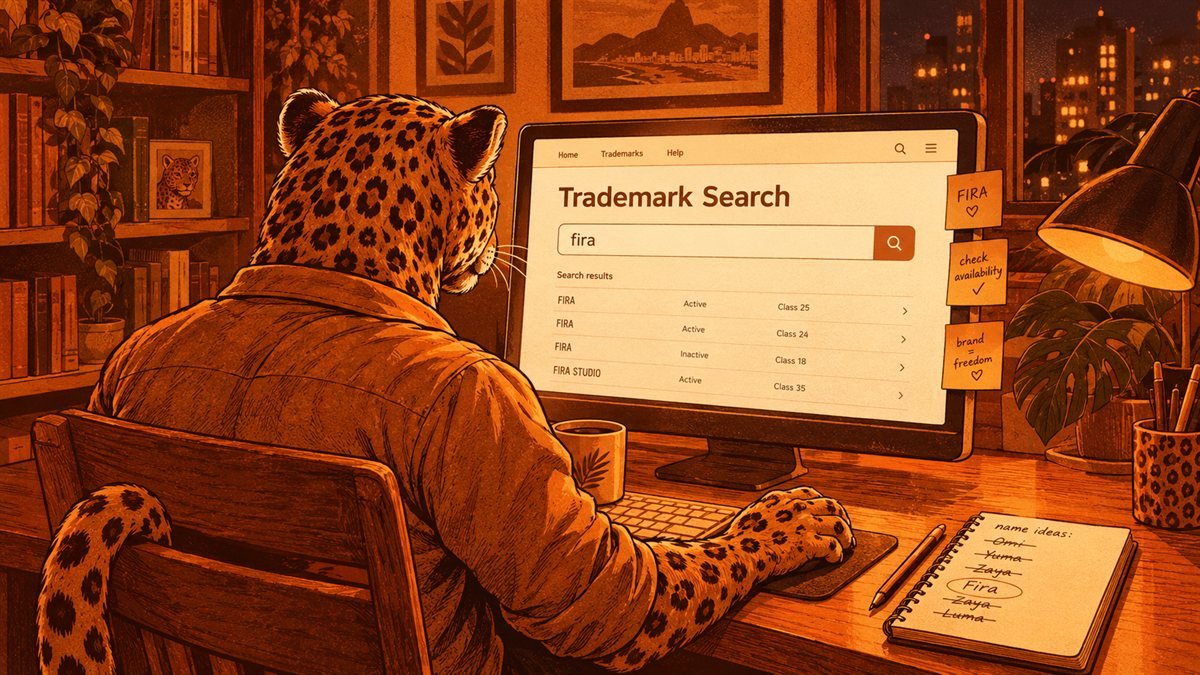
You have a project idea: a new business, an app, a game, whatever you're building. Now you need a name that means something to the people you want to reach. It should be easy to say, easy to remember and tied to the story you want to tell.
And of course it has to be legally available, so you can make it officially yours. And nope, that part isn't free, so get your wallet ready.
In this article I'm walking you through the process I use to name a new project.
Step 1: Start with your project idea
Do you already have a mission, a vision and values? Any prototypes or product mockups? You need a base to build on and measure against. A name without that base is just an empty word.
So start with why you're doing this and who you're designing it for. Keep those two answers handy, because you'll use them in every step that follows.
Step 2: Brainstorm, and go for quantity
There are a few methods you can use here, alone or combined. What matters at first is getting past the blank page. For now, quantity beats quality.
I usually write down whatever comes to mind from Step 1, without judging it. Then I set a few criteria and bring in AI to help. Ask yourself, with your target audience in mind:
- Should the name carry a specific emotion?
- Should it be straightforward and say what you do?
- Should it be abstract and playful?
- What mood do you want it to create?
- What language(s) should it work in?
With those answers, I use a prompt like this with Claude or any AI tool you prefer. Copy it, fill in the brackets and go:
Hi Claude. I'm developing a new project and need help brainstorming names. Mission, vision and values: [paste yours] Target audience: [who they are, where they live, what they care about] Language(s) the name must work in: [e.g., English and Portuguese] Mood I want the name to convey: [e.g., warm, bold, calm, playful] My initial ideas: [list your raw ideas, even the rough ones] Please generate 35 name ideas for each of these categories: emotional, sound-based and straightforward/descriptive [or swap in your own categories]. Keep them short, easy to pronounce and easy to remember. Give a one-line rationale for each name.
Step 3: Narrow it down to your top 10
Once you have 100+ names (three categories × 35 gets you there), pick your 10 favorites. Then go back to the AI and ask it to analyze each one: every possible meaning and connotation in your target language(s), and whether a well-known brand is already using something similar. The AI gives you a first filter. It doesn't replace the official search in Step 4.
As a graphic designer, I also look at each name from a visual point of view:
- Will it work as a logotype?
- Is it too long?
- Does the letter count, or a two-word combination, already suggest interesting graphic possibilities?
By this point you'll probably find that some names are already taken, and others don't fit the idea as well as you thought. That's normal.
Let it rest. If you can, set the project aside for a few days or even a couple of weeks. Let the names sit in your head and work in your subconscious. The right one usually becomes obvious.
Step 4: Test your top 3
Take your three favorites and check their availability. If you're launching in the US, use the official USPTO Trademark Search. For other countries, search your national trademark office, or start with the WIPO Global Brand Database, which covers many countries at once. In Brazil, that's INPI.
Then evaluate each finalist:
- Is it easy to pronounce?
- Is it short enough to become a strong logotype?
- In which languages can it be said easily?
- Does it have negative meanings in other languages? Which ones?
Step 5: Pick your winner and make it official
Register it, pay the fees, and start building your visual identity!
The bureaucratic part: making your name official in the US
There are four official channels, listed from most to least protective. They are not the same thing, so it helps to know which one solves which problem.
1. Federal trademark (USPTO): what actually protects your name
This is the registration that protects your brand name nationwide.
- Search first: USPTO Trademark Search
- Apply: Trademark Center, the USPTO's current filing system (it replaced the old TEAS forms for new applications in 2025)
- Fees: the base fee is currently $350 per class of goods/services. Fees change, so always check the official fee page and the 2025 fee changes summary.
Step by step, in short:
- Search the official database for your exact name and names that sound similar.
- Choose the right class(es) of goods/services. For example, software and apps usually fall under Class 9 and/or Class 42. Many businesses fit in more than one class, and you pay per class.
- Choose your filing basis:
- Use in commerce: you're already selling or using the name publicly.
- Intent to use: you haven't launched yet but plan to soon. This secures your place in line before launch.
- File through Trademark Center and pay the fee for each class.
- Wait for examination. You may get an office action asking for changes or clarification.
- Publication for opposition. If approved, your mark is published and third parties have 30 days to oppose it.
- Registration. If you filed as intent to use, you'll need to prove actual use before final registration.
Heads-up if you live outside the US: since 2019, the USPTO has required applicants domiciled outside the United States to be represented by a U.S.-licensed attorney. If that might apply to you, confirm with an intellectual property attorney before filing. Official info: USPTO rule on foreign-domiciled applicants and Do I need an attorney?
2. Business entity name (LLC/corporation): state level
Registering an LLC or corporation reserves the name only in the state where you register it. It is not national brand protection. This is done through each state's Secretary of State website. Official overview from the U.S. Small Business Administration: SBA — Choose your business name.
3. DBA ("Doing Business As" / fictitious business name)
You only need this if you operate under a name that's different from your company's legal name. For example, your LLC is "Jane Smith Creative LLC" but your product is called "Bloom." DBAs are filed at the county or state level, and the rules vary by state. The SBA guide explains when you need one.
4. Domain name (.com, .app, etc.)
A domain isn't a government registration, but it's the most immediate practical step. You can buy one from any ICANN-accredited registrar (Namecheap, GoDaddy, Squarespace Domains, etc.). Official list: ICANN Accredited Registrars.
The practical order I recommend
- Informal search + USPTO search to rule out obvious conflicts
- Buy the domain to lock in the name while you decide the rest
- File the federal trademark when you're ready to launch. An intent-to-use application can secure your position earlier if you want to move ahead.
A quick reminder: I'm not a lawyer. This is a map of the official channels, not legal advice for your specific situation.
I hope this article gives you a solid starting point for your own naming process!
Bonus: a naming strategy worth studying
Kibon, one of Brazil's best-known ice cream brands, is a great naming case. The brand is sold in dozens of countries under different names adapted to each local culture. What stays the same everywhere is the heart-shaped symbol, the "Heartbrand."
This is marketing strategy at its best: a brand that studies each local audience and adapts instead of imposing one name everywhere. Meanwhile the visual stays consistent, so it's still instantly recognizable. If you're Brazilian and you spot that heart in Switzerland, you know exactly what it is. Interesting, right?
Some of its names around the world:
| Country / Region | Name |
|---|---|
| Brazil | Kibon |
| UK, Ireland, Indonesia, Pakistan, China | Wall's |
| Italy, Greece, Turkey, parts of Eastern Europe | Algida |
| United States | Good Humor |
| Spain | Frigo |
| Portugal | Olá |
| Netherlands, Belgium | Ola |
| Germany | Langnese |
| France | Miko |
| Mexico | Holanda |
| Chile | Bresler |
| Australia | Streets |
| Sweden | GB Glace |
| Switzerland | Lusso |